
From Retail to Restaurants: Who Gets Grants and Who Doesn’t
While the Canada United Small Business Relief Fund is now closed, understanding how grant eligibility works has never been more relevant for Canadian business owners. This guide separates retail and restaurants (still strong candidates) from gaming operators (almost always excluded), explains the growing shift toward financing over grants, and shows where to look for real funding today.
Sector | Grant eligibility | In short |
|---|---|---|
Retail | Usually eligible | Local shops fit most programs, as long as gambling income stays out of the mix |
Restaurants and food | Strong candidate | Among the most supported sectors, with fresh 2026 programs |
Gaming and gambling | Almost always excluded | Casinos, bingo halls, racetracks and online casinos rarely qualify |
Baseline Eligibility: What Most Grants Require
Before looking at any specific industry, it helps to know the baseline. Most Canadian small business grants share a common set of requirements.
What most grants expect of a business:
- Registered with the CRA and holding a business number
- Operating within Canada
- Meeting the program’s size or stage criteria
Sometimes: matching funds, a business plan, and good standing with tax authorities
A few changes arrived in 2026. For certain federal innovation-focused programs, eligibility tightened: businesses now need a minimum of three full-time employees and $300,000 in revenue in some cases, up from earlier thresholds that accepted one full-time equivalent and $100,000. The baseline bar matters, but the real differences show up when you look at specific industries.
Retail Businesses: Usually Eligible, With a Few Catches
If you run a local retail shop selling clothing, books, hardware or gifts, you are in the strongest position for grant eligibility. Most programs are built for exactly this profile. The Sarnia-Lambton Small Business Support Grant, for example, explicitly lists retail among its eligible sectors and awards grants of up to $4,000 to qualifying local businesses.
That said, retail has a few lines it should not cross. Some grants exclude businesses whose primary revenue comes from lottery tickets, tobacco, or alcohol. If a retail shop also runs an online casino affiliate link on its website, or earns significant income from gambling promotion, it may be flagged for exclusion under certain programs. The general rule: a local shop that sticks to its core merchandise is almost always welcome to apply.

Restaurants and Food Services: Strong Candidates with a Specific Edge
Restaurants remain among the most supported sectors for grants, and in 2026 targeted funding continues. The federal government invested $2 million into the Foodpreneur Lab’s Step Up Scale Up program, a 16-week initiative helping 75 selected food entrepreneurs scale their businesses. The City of Toronto launched a Dining District Program offering grants of up to $5,000 for restaurants and bars to expand and enhance outdoor dining, with a $25,000 stream available for eligible projects that can be delivered during fall 2026.
Restaurants should be aware of the same boundary, though. If a restaurant hosts VLTs on site, or prominently promotes an online casino in its marketing, some grant programs may question its eligibility. This does not mean every restaurant with a gaming machine is disqualified, but the safest approach is to be clear about revenue sources when applying.
Who Is Almost Always Excluded? Gaming and Gambling Operators
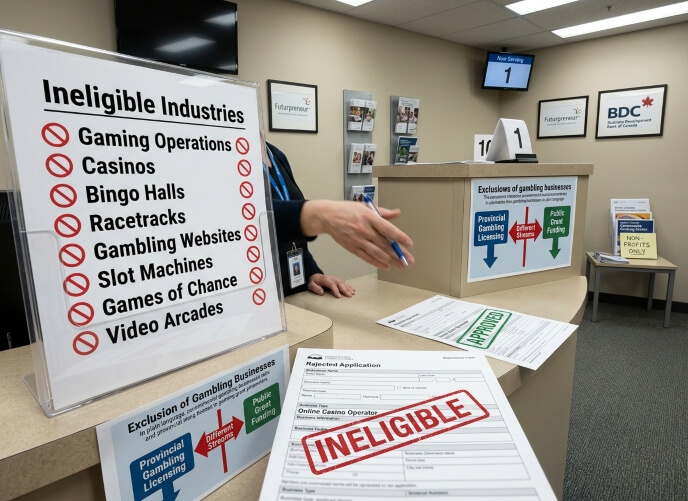
This is where the lines are drawn most sharply. If your primary business is operating an online casino, a physical casino, a bingo hall, a racetrack, a gambling website, or any form of video arcade with gaming machines, you are almost never eligible for standard Canadian small business grants.
Almost never eligible for standard grants
A business whose core is an online casino, a physical casino, a bingo hall, a racetrack, a gambling website, or a video arcade with gaming machines.
Several major funding organizations exclude this sector outright. Futurpreneur, one of Canada’s largest startup funding programs, lists gaming operations among its ineligible industries, including casinos, bingo halls, racetracks, gambling, slot machines, games of chance, and video arcades. The BDC also excludes gaming establishments from its Business Accelerator Loan program and other financing streams, though the BDC mostly offers loans rather than grants.
Why the blanket exclusion? Government policy consistently treats gambling as a regulated and socially sensitive activity, and governments rarely fund businesses whose core model relies on gambling revenues. Provincial authorities control most gambling licensing, and public money is not generally directed toward for-profit gaming operations. The main public funding connected to gambling comes through Community Gaming Grants in provinces like British Columbia, and those are exclusively for non-profit organizations, not for-profit casinos or online casinos. Some exceptions exist for Indigenous-owned gaming operations, which may have separate agreements with provincial governments, but those sit outside the standard small business grant system.
If You Run a Gaming Business, Where Should You Look Instead?
It is not a dead end, but the path changes. If you operate an online casino or any gambling business, you will not qualify for IRAP, CanExport, Futurpreneur, or most regional development grants. Instead, look at these alternatives.
- General business loans. The Canada Small Business Financing Program (CSBFP) is open to for-profit and not-for-profit businesses in nearly all industries across Canada. The only sector it explicitly excludes is farming, which has its own dedicated program. Loans of up to $1.15 million are available to eligible businesses. A loan is not a grant, but it is accessible.
- BDC financing. The Business Development Bank of Canada provides loans, venture capital, and advisory services. While the BDC excludes gaming establishments from some programs, other products may be available depending on the nature of the business. It is worth a conversation.
- Private investment or angel funding. Many online casinos and gaming platforms are funded through private equity rather than government programs. This is the most realistic avenue for pure gaming operators.
- Provincial gaming authority programs (rare). Some provincial gaming corporations allocate funds to community organizations and non-profits from gambling revenues. These are not small business grants and do not apply to for-profit online casinos.
The Shift From Grants to Financing
It is worth noting a broader trend. Many of the high-profile pandemic-era grant programs are now closed. The Canada Digital Adoption Program closed in 2024. The Canada-Ontario Job Grant paused in November 2025. Even the Canada United Small Business Relief Fund, which distributed $14 million, has been closed for years. The 2026 landscape leans more heavily on loans, tax credits, and targeted sector-specific grants. That is not bad news in itself, but it does mean managing expectations and knowing which of the three you are applying for.
Grant
Free money you keep. A true grant, like CanExport, is not repaid.
Loan
Borrowed money you pay back. CSBFP and BDC financing are loans.
Tax credit
Money returned through your filing, the way SR&ED works.
The 5-minute Eligibility Check: Where to Start
The fastest way to find out if you qualify for anything is the federal Business Benefits Finder on canada.ca. It is a government-backed database of funding programs, tax credits, wage subsidies, and loans across federal, provincial, and territorial levels. You answer a few questions about your business, and it returns programs tailored to your sector, size, and stage.
From there, check your provincial or local chamber of commerce, which often knows regional grants that never appear on national lists. The regional development agencies for each part of Canada also run funding specific to where you operate. And if you are a restaurant or retail shop, you are in good shape, just make sure you are not also in the business of running an online casino on the side.