
If you are looking for Canada United in 2026, here is the honest version: the campaign is finished, and this is not the team that ran it. We keep this page as an independent record of what happened, with no tie to the Royal Bank of Canada or its partners. Canada United was a shop-local push built during the first year of the pandemic, and the contest and the relief grant closed years ago. What remains is worth knowing: what the campaign was, who built it, how it worked, and where to look now if you want to back local businesses or find funding of your own.

The campaign in brief
Launched | summer 2020, led by the Royal Bank of Canada |
Built toward | the Canada United Weekend, August 28 to 30, 2020 |
Coalition | 70+ partner brands and organizations, plus the chamber network |
Relief fund | grants up to $5,000, more than $14 million in total |
Status today | closed |
What Canada United Was, and Who Built It
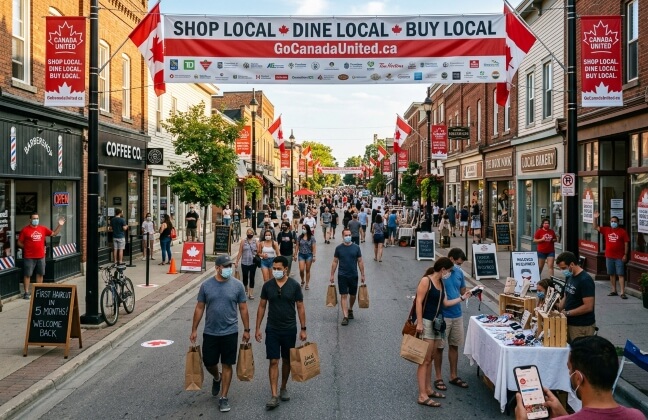
Canada United was a national campaign with a single request to the public: buy, dine and shop local while the economy reopened. The reasoning was plain. Local businesses were the part of the economy hit hardest and fastest in 2020, and everyday spending was the quickest help on offer. The name carried the pitch on its own, a united Canada getting behind its own main streets.
The Royal Bank of Canada created it and ran it as the lead, launching in the summer of 2020 and building toward a single weekend in late August. From the start, it was framed as a short push rather than a permanent body, and it lived mostly online at GoCanadaUnited.ca and across social media.
What set the Canada United campaign apart was the size of the tent. By the time it wrapped, more than 70 partner organizations had signed on, from household retailers to the country’s chamber network to a handful of civic and utility names that rarely appear on the same poster.
The coalition, grouped
Creator | Royal Bank of Canada |
Major brands | Canadian Tire, Tim Hortons, Hudson’s Bay, WestJet, Indigo, Roots, Boston Pizza, Sobeys, Staples, TELUS, Petro-Canada, Pet Valu, Sleep Country, Home Hardware, Leon’s, The Keg, Spin Master, Mastermind Toys, Well.ca, eBay Canada |
Chamber network | the Canadian Chamber of Commerce plus the provincial and territorial chambers, from Ontario and Quebec to BC, Alberta, Manitoba, Saskatchewan, the Atlantic, NWT and Yukon |
Industry bodies | Retail Council of Canada, Restaurants Canada, the Canadian Federation of Independent Business, Digital Main Street, MNP, Intuit |
Civic and utilities | City of Toronto, Bruce Power, Ontario Power Generation, Canadian National Railway |
Media | Corus Entertainment, Postmedia, Toronto Star, TLN Media Group |
How It Worked
Most of Canada United asked for small actions rather than donations, and that was deliberate. The bar to take part was kept low on purpose, so almost anyone could join in without spending a cent. There were three ways people and businesses got involved.
Watch and share
Each video view, like or share added five cents to the relief fund, up to a $2 million cap.
Shop the weekend
Shoppers were pointed to one shop-local weekend, with a prize draw as the hook.
Kit and grant
Businesses got a free marketing kit and could apply for a grant of up to $5,000.
The full mechanics of each track live on their own pages. The weekend and its contest are laid out on the Canada United Weekend page, and the business side, the grant and the marketing kit, on the for local businesses page.
The Numbers It Reported
When the campaign wrapped, the Royal Bank of Canada published its own results. Read them as the organizers’ reported figures rather than an independent audit, but the scale is hard to miss.
93%+
of Canadians reached across TV, online and social
875M+
impressions during the campaign
50M+
video views, likes and shares
$2.1M+
raised through public engagement
550+
news stories covering it
44
cities marking the weekend
Two figures sat underneath the reach. Public engagement alone raised more than 2.1 million dollars for the relief fund, and once the federal government and partners added their share, the fund passed 14 million dollars. That money went on to help more than 2,000 small businesses across the country.
The Status Today
Canada United is over. The contest ran once and closed when the weekend ended. The relief fund stopped taking applications after it reached its limit. The Canada United website that once ran all of this now serves as a record of it, which is what this site is. Nothing here takes applications, sells anything, or speaks for the bank or its partners.
How to Support Local and Canadian Businesses Now
The campaign is done, but the habit behind it still holds up, and you do not need a campaign to act on it. A few practical ways to back local businesses and Canadian companies:
- Spend where it stays. Independent shops and restaurants keep more money moving in the neighbourhood than large chains do, so a regular coffee or grocery run is a small vote for Canada local business.
- Switch a few habits. Pick Canadian companies to support in categories you already buy, from clothing to software, and move a handful of recurring purchases across.
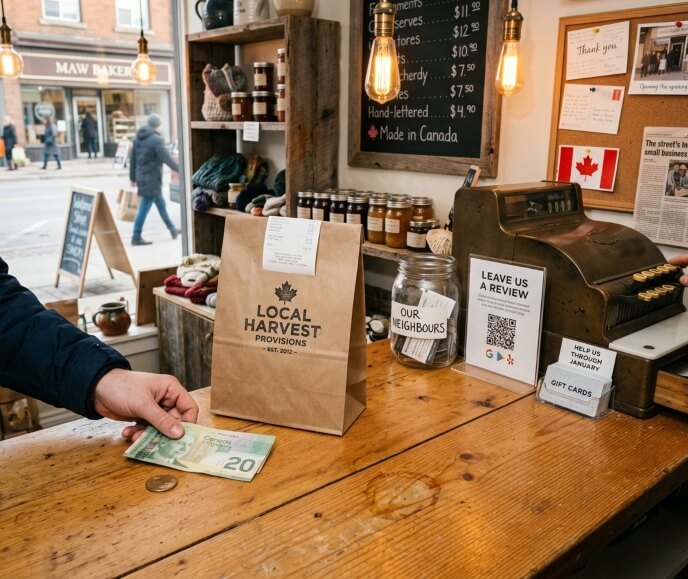
- Say it out loud. A genuine review, or a recommendation to a friend, costs nothing and brings in more business than most advertising.
- Smooth the lean months. Gift cards and bookings made ahead help a shop’s cash flow when foot traffic is thin.
The way to support local business is less about one grand gesture than about where the next ten purchases go. And if you run a business rather than shop at one, the funding picture has moved well past 2020. The programs open today are listed on the Canada United Small Business Relief Fund.
Common questions
No. It ran in 2020 and closed that year. The Canada United website is now an information page, not a live campaign.
The Royal Bank of Canada built and led it, working with the national chamber network, major industry associations, and more than 70 partner brands and organizations.
No to both. The contest ended with the August 2020 weekend, and the relief fund closed once it reached its application limit.
No. This is an independent record of the campaign, not affiliated with RBC or its partners.
Start with the fund page on this site, which tracks the programs that are currently open.
About this website. This is an independent information resource about a campaign that has ended. It is not affiliated with RBC, the Ontario Chamber of Commerce, or the Government of Canada. Programs and figures change over time, so confirm anything current on the official sources before acting on it.